

CUsco
A view of Cusco taken from Mesa Redonda
Time spent: 43 days; 4 Apr 2025 - 17 May 2025
Elevation: 11,286 ft (3440m)
Currency: Peruvian Soles
Lodging Cost: $16.91 per night; Airbnb

The stairs outside my apartment. Had to traverse these mother fuckers every time I left my place.
Arriving in Cusco
I almost don't know where to start with Cusco. Even without Machu Picchu being nearby, this place would still be a world-class tourist destination. There is a lot to talk about with this city.
I guess the first place to start would be the airport. You probably will be flying in from Lima, but there are some travel tours of Peru that take buses here. The airport is surprisingly small for such a big destination. When you walk out, there will be tons of taxis, of course, taking you wherever you need to go. Uber is here, and I'd recommend taking that. I was tired and had already stopped at the ATM and had soles, so I just agreed with the first cab that approached. The cabs in Peru don't have meters; you negotiate a price beforehand, so be prepared for that if you take one. The guy said 70 soles ($20), and I just agreed. Later, I was curious and checked the distance from my place to the airport, and it was about half of what he charged me.
Another option is an app called inDrive. I thought this was an interesting app, and I did use this a few times in Peru. When you register, you don't need to put in a credit card. Instead, you tell the app where you want to go and then make a bid. The app gives you a recommended bid, and I usually just chose that. The driver sees your bid and destination and then decides if he wants to accept it. When he drops you off, you just pay them the cash. No tip required. I had no problem using Uber in Cusco, but in a couple of other cities in Peru, Uber is available but not widely used. Drivers get more money from inDrive, so they prefer that.
As for lodging, most people stay in the area around the Plaza Mayor de Cuzco. There are nice local hotels and major chains like Hilton and Airbnb, as well as plenty of hostels. If you are staying in that area, be aware the prices at restaurants will be a good bit higher. I stayed a little northwest of that because I always like being away from the hustle and bustle. If you do that, one thing to consider: Cusco is a very hilly town, generally from northeast to southwest. With the higher elevation, it really kicked my ass just walking home from the grocery store.
If you are staying in the area, Mercado San Blas is the best place for some delicious food and fresh juices at local prices. I ate lunch here almost every day. On the other side of Plaza Mayor de Cuzco is Mercado Central de San Pedro, another much bigger market. There are a lot of food stalls here and souvenirs for sale in and around it. It also had a bigger selection of fresh meats. I ate lunch at San Blas, but went here to stock up on meat and cheese for making sandwiches at home.
Another thing to be ready for is the cold. I was woefully unprepared for how cold it was in Cusco. All I brought was a light hoodie, and I was quite cold in the mornings. My apartment didn't have AC or heat, and it never seemed to warm up during the day. I ended up buying some warmer clothes while I was there.

Streets of Cusco, hills everywhere

Outside Mercado Central de San Pedro
Boleto Turistico, Tourist ticket
One of the first things you will likely need to do to get started with the sightseeing is get the Cusco Tourist Ticket. This allows you entry into 16 sites in and around town.
If you've been researching Cusco, you’ve probably seen a ton of people asking, "Is the tourist ticket worth it?"
Let’s clear that up right now: it’s not about whether it's "worth it." This isn't a special bargain pass or a coupon booklet designed to save you money on a bundle.
It’s a mandatory entry ticket. The local government grouped these historical sites into specific circuits, and they do not sell individual tickets at the gates. If there is a specific ruin you want to see, you have to buy the ticket that covers it. Period.
That said, yes it is worth it, even for just a few sites. I got the 10 day ticket for 130 soles ($38). There is a couple of cheaper versions for only a few sites with one or two days validity for 70 soles ($20).

Cusco Tourist Ticket.
I visited all 16 sites and will tell you which are worth it and which can be skipped.
Click HERE to see a quick breakdown on all of the sites.

Catedral del Cuzco in the town square. This spot is the alpha and omega. The heart of Cusco.

Even though it is a popular tourist town, the ancient streets aren't that walkable. Very narrow roads and sidewalks are everywhere.

Pacarina Mosoqllaqta. This was just right down the road from my apartment. You couldn't throw a rock in this town with hitting something cool. A seriously cool area with a cave, a path and a pretty stream and it is barely noticeable on Google maps.

When I walked up to this cave I thought "back home, that is where kids would sneak away to drink or smoke". I decided to see what was in the cave. Four teenagers in there ripping ciggies.
Saqsaywaman, Tambomachay, Puka Pukara, Q'engo,
There are four ruins on the tourist ticket that are in town. You can see them all in half a day, and it is worth checking them all out. For all four of these you NEED the tourist ticket. There is no other way to enter the sites. You CANNOT pay cash for a single entry ticket.
Now, Uber tries to pull some shady shit here, and I have since been keeping an eye out for this whenever I use them. What I planned on doing was taking an Uber all the way up to Tambomachay, which is all uphill and the furthest away, and then walking down and seeing the others as I go. I punched in the destination, and Uber was charging 110 soles ($32) to go there. That didn't make sense to me because my ride from the airport would have been less than a third of that, and the airport was further away. Well, instead of typing in the destination, I just dropped a pin at a random spot right outside of it, and it dropped the cost to about 25 soles ($7.30). So I chose that ride.
Well, I got picked up, and I guess the guy realized what I did when we were on our way and asked if I was going to Tambomachay. I said I was, and he told me I didn't select that destination and I needed to pick that, or he would have to end the ride. We were already at the top near Saqsaywaman, and I said if he couldn't take me for the cost he agreed to, to just let me out there. So he did, and Uber didn't charge me for the ride. I get he wanted more money, but I thought he was kind of dumb because he ended up getting nothing. I didn't feel bad because I really don't feel like I was ripping him off—I just wasn't allowing myself to be ripped off and was paying the normal cost for a ride of that distance.
Anyway, I ended up going to Saqsaywaman first, and it kind of worked out better anyway, which I'll explain later.

Cristo Blanco, White Christ. The one in Rio de Janeiro is the granddaddy of them all but you see these on peaks all over South and Central America. This can be seen from Cusco's main square.

I didn't see a rule saying don't touch the llamas, but don't touch the llamas.

Couldn't have asked for better weather. I got some great pictures against the blue sky.
Now, if you only go to one ruin in the city, go to this one. Saqsaywaman is by far the best. There are some tours you can take, but as a personal preference, I never take tours if I can go myself, so I skipped it. You can easily walk here from the city—well, I say easily, it is only about a 20-minute jaunt, but it is all uphill. Having a guide would have told me a lot more of the history, but I just enjoyed looking at the pretty rocks and cute llamas.
Where I got dropped off was at the highest point next to the Cristo Blanco. I took some photos of that, then walked down a little path into the ruin.
There are also some great lookouts where you can see the whole city.
Another thing of note is that there is a scene from Transformers: Rise of the Beasts that was filmed here. There was actually a lot of that movie filmed in Peru, but this spot is easily recognizable.
After you get done here, head to the north entrance of the park, and there will be a bunch of taxis waiting. To get to Tambomachay from here was 15 soles ($4.40).

This wall went pretty much the whole length of the ruin and was made without mortar

The entrance to park. That road was a lot harder to walk on than it looks. I walked on the dirt.
Tambomachay should be a pretty quick stop. Honestly, the walk down the path, albeit not that far, will probably be half of your time here. I'm not saying it isn't neat, but it is small.
After that, almost directly across the street is Puka Pukara.
Pretty much all of Tambomachay, at the end of the video you can see Puka Pukara


These two sites are pretty much the only things of note in the park. Across the path from one is big rock you can climb up to get a good view of everything. The water is fed by a natural year round spring so it is quite a remarkable bit of engineering from the Incan people.

A picture doesn't do this justice. It is hard to put into words how fucking incredible this view really was I'd be hard pressed to think of a better view in all of my travels.
Puka Pukara is small as well, but I think it is a bit cooler than Tambomachay. But the real prize here is the view.
From the back of the ruins, you get an absolutely STUNNING view of the Andes mountains going off into the distance as far as you can see. It was legitimately one of the most amazing views I have ever seen.
After this, you've got a bit of a hike back down; it was further than I expected. It took me about an hour. But it is a pretty picturesque walk, and it is all downhill.
There is a small village called Huayllarcocha about a 10-minute walk from Puka Pukara if you want to stop and get lunch.
If you do walk, be careful because there is no sidewalk.


A little bit bigger with some more stuff than the last stop.
If you do choose to walk, guess what? BONUS ruins!
This isn't on the tourist ticket, and it wasn't even on my radar, but out of this place and the four tourist ticket sites, I'd rank this as the second best. I didn't know about it until I was just checking the map to see how far I was from my final stop and saw I was close.
It is free to enter, and there were lots of local families here picnicking and kids playing. Once you see the entrance, there is a huge field you have to cross, and said field has a fair amount of horse shit in it. But it's totally worth it. It has another great view of a mountain. The actual ruins are roped off, but you can climb the hill behind them and get a great bird's-eye view.

View from atop the Temple of the Moon

This was as close as you could get from the ground

I have a sneaking suspicion these were the culprits behind the turds on the ground

Not a bad place to put a supervillain lair
The next and final stop is the Q'enco Archaeological complex. It is more natural than the rest. Really it is just a few giant rocks, but you can walk under them. Honestly, you probably won't spend more than 10 minutes here but it is near a pretty nice park that you can walk around.
You'll also find some vendors selling bottles of chicha morada. You'll probably find this a lot of places in Peru but this where I first tasted it and fell in love with. It is a drink made with purple corn, pineapple, cinnamon and few other things. It is a really unique tasting drink, but not unique like fried grasshoppers, just unique like a flavor of Kool-Aid you have never had.
Also if you want to check out the northern side of town, this is the best time to do it. There really isn't much to see but if you have been wondering where all the endlessly high flights of stairs go to, you'll now be at the top

Q'enqo Archaeological Complex
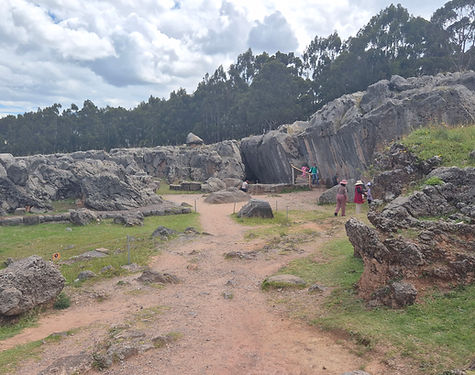
You can walk under that dark area

The start of the hike back down to town

It feels kinda remote where the bus drops you off...and it is. But just head toward that sign and over the hill and you will be fine.
How to get to Tipon and Pikillaqta
These two sites are also offered on tour groups from Cusco. Like the last four, you need the tourist ticket for these. Even if you book a tour, you will still need to have a valid tourist ticket. The entrance to none of these places is covered through tours.
This was the first trip I took on my own outside of a foreign town, and I was glad I did. You will miss A LOT at Tipon if you go with a group.
First thing you want to do is catch a bus heading to Urcos. Go to the Urcos Cusco Terminal. You won't be waiting long, and the cost was only 5 soles ($1.46). If you are interested, you can go see Urcos. It is a small town with a couple of old churches if you want to check it out. I skipped it.
Before you leave Cusco, make sure to download offline maps of the area because it is kinda remote and the signal can be spotty. Make sure you tell the driver you are going to Pikillaqta. You don't really need the map to avoid getting lost, but you want to keep an eye on it to make sure the driver remembers your stop. If he forgets, just say "proxima parada" when the bus starts to get close, though he'll likely remember.
Now, the bus drives through the town of Tipon, but don't panic passing through, you are going to hit it on the way back.

You can almost imagine these roads being packed with Wari people walking going about their day to day lives.

I didn't have a guide so I don't know what this was, but I assume, like many other sites, there was wooden and/or grass roofs that didn't last the test of time
Unlike the other sites on the ticket, Pikillaqta is unique in the fact that it is not an Incan site. It was made by the Wari, who ruled the region from about 600-1000 AD, before the Incas rose to power.
The Wari must have been a little OCD, because unlike the Incans, who often followed the natural curves of the terrain, the Wari liked rigid, grid-like patterns, and you can really see that at this site.
Also, their walls are built in a different style than the Incans'. Notice at the rest of the sites you visit how most of the stones are shaped and interlocked together. The Wari didn't do that and just took whatever small stones they could and slapped them together with mortar.
Even though the site is huge, evidence suggests that it wasn't quite finished and was abandoned around 1000 AD.
A view of Pikillaqta from one of the 4 towers located in each corner.
The whole site is a maze of roads and high walls. There is a courtyard and four towers, one on each corner of the site, though only three are accessible. They aren't really that high, maybe six feet above the rest of the site, but they do allow a great view of the whole place. Hell, you almost need them to plan your route because, with all the high walls, it really is a maze.
After you are done here, head back to where the bus dropped you off (actually, you probably could have done this before you went to Pikillaqta) and check out Rumincolca. It is a giant stone gate, and on the other side is another great shot of a valley going off into the distance. If you want to head up the road a few hundred meters to get some photos of Lake Lucre (Huacarpay), you can. After that, just walk up the road to the bus stop by Pikillaqta and keep your eye out for a bus heading west that says "Cusco". Flag them down, tell them "Tipon", and hop on. This ride should only be 3 soles ($0.90).

I sell my photos on a stock photo website and this was my first photo sold and my best seller.

Stupid giant wall blocking my view of the mountain

This part of the site is mostly inaccessible

Rumicolca Gate

The view from behind Rumicolca Gate

Laguna de Huarcarpay

The welcome to Tipon sign. There is a statue of a guinea pig across the street.
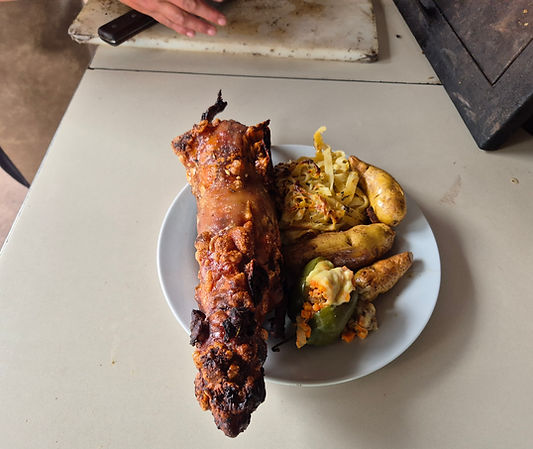
Warning: If you consider yourself squeamish, whatever you do, do not look at the photo above this caption. It contains cuy. A fried guinea pig.
The bus stop in Tipon is at the main intersection in town. There will be a few cabs waiting here, and they will take you up to Tipon. Shouldn't cost more than 25 soles ($7.30) for a one-way trip.
Now before I get into the archaeological site, I want to touch on Tipon the town. This place is the "Cuy Capital of Peru", and that actually probably makes it the "Cuy Capital of the World".
What is cuy (pronounced Coo-ee), you ask? Cuy is what we call guinea pig. The cute little critters we keep as pets are food in the Andean region of Peru. It actually does make sense. They grow and reproduce fast, they require almost no resources to feed as they just eat grass, which is everywhere, and unlike say rabbits, they aren't going to make a quick getaway if they get loose.
About every other building on the main street in Tipon is a guinea pig restaurant. I say "when in Rome...", and I definitely recommend trying it after you work up an appetite exploring the ruins.
It tastes like chicken, nothing really extraordinary about the meat, but the way the skin was cooked is what made it so good! The skin turns into a hard, crispy shell when cooked in the outdoor oven. Muy delicioso! The place I was at served it with noodles, potatoes, and a stuffed pepper. I also got a nice cold beer to wash it down with. It cost around 30 soles ($8.75), which is somewhat pricey for a meal in Peru, but I'd definitely spring for it if you aren't scared away from eating the animal you used to have as a childhood pet. Now, they do serve the thing whole, so it still has a head, ears, and a smiling face. But don't worry, all the guts are taken out of it.
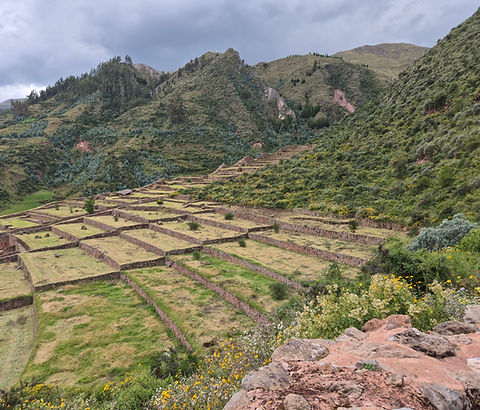
Now, at first glance, when you enter Tipon, it appears to be a rather small site. You will see a small fountain when you enter, and then as you get to the top of the steps, you will see a huge, horseshoe-shaped area with different tiers.
These tiers were a sort of Incan experiment. Each tier had its own microclimate where they could test different soil compositions and control the flow of water.
Now, you can't build something this badass just for some dumb shit like science. You've also got to add some ceremonial rooms and residences for the Emperor, and you can see these at the back of the site.
Now, if you take a tour here, this is all you will see, but there is much, MUCH more to this area.


This shot of the royal buildings wouldn't be available if you go with a tour group.

500 year old spring fed fountain
Now, after you enter, the path will lead you to the left and then all around the horseshoe. I followed it, but not long after you get on that path, you'll come to a staircase. If you stare straight ahead, it is possible to not see this stairway at all, but as long as you keep your eyes open, you shouldn't miss it, even though it is quite overgrown.
Now, I heard something a long time ago: To escape any labyrinth, just put one hand on the wall and walk forward. Eventually, you will travel through the whole thing and get to the exit. This is usually what I do when going through a museum or site. Just keep making all left or right turns, and eventually you will see everything and end up at the start. This is why I went up the stairs. Little did I know, that detour would take me about two and a half hours, and I wouldn't see a single other person for that entire time.
At the end of this video I say "The hard part is over". Shortly after I take this, I realize that is a lie.

The "secret staircase" to watch for
When you hike these stairs, you will see a few signs and distance markers guiding you to "Intiwatana". The stairs do go up over a kilometer, and it is about a 20- to 30-minute hike. But when you get there, you have an excellent view of all of Tipon, the city, and the archaeological site.
When you get there, Intiwatana looks like a small fort, but it is actually a calendar and a shrine, which makes sense because the place below was built for farming, and when planting crops, timing is everything.


An Intiwatana is usually situated at the highest point of a site. It literally translates to "the hitching post of the sun". It serves two primary functions, an astronomical clock and calendar, and as a ritual to "hitch" the sun. During the winter when the days were shortest, they thought the sun was in danger of slipping away entirely, so they would hold a ceremony to symbolically tie the sun to the pillar to hold it in place.
I was about to leave and head back down when I noticed a small drain leaving the structure. I decided to see where it ran to, and then I found a whole other path. I was kind of hesitant to follow it, but I assumed since it was cleared of vegetation, it had to lead to somewhere.
I spent a long time following this path over hills and I started to almost worry. The site closed at 4:30, and I wasn't sure if they checked or if it would close without me, leaving me to walk down the mountain in the dark. Still, I was determined to get to the end.
It is also a little scary because, as I said, I didn't see a single person. I didn't have cell reception and this path wasn't THAT safe. There are a lot of narrow spots that have a steep drop on the sides, and on a few of the hills you go over, you have to navigate some rocks. Not trying to scare you, it isn't that challenging, but be careful. A badly sprained ankle would really fuck up your day this far out.

I followed this little drain and it just kept going and going...

...and going...

...and going...

...and going...

...and going.
After about another 45 minutes of following the drainpipe, you will come to a rock that says "Pukara." Follow that arrow, and it will lead you to another ruin.
Now, Pukara means fort, but this looked like another irrigation system, so I don't know exactly. The place has some great views, and where the trail dumps you out is probably the best spot for photos.
I'm pretty sure the path leads somewhere you can actually get into the ruins, but I didn't go down into them. I was starting to get a little pressed for time and still hadn't seen all that much of the main area of Tipon.
The walk back did go a lot faster, and I made it back with enough time to do a quick loop and see the rest of the park. There was only one cab waiting there, and I got really lucky with that. Walking back down was an option I was prepared for, and while it wouldn't have been the end of the world, I was getting fucking hungry. The walk down would have taken about an hour, all downhill, but with nothing to see but farmland.


Day Tours From Cusco
There are two main day tours available from Cusco of course the main reason you came here was to see Machu Picchu so I added that below as well but since I didn't actually go with a group, I don't really count as a "day tour" but that is just semantics.
Monumento El Inca Pachacutec
I'm gonna wrap up the page on Cusco because there is just too much to do to give you a step-by-step listing of all that is good here, but these two involve the tourist ticket so I want to mention them.
The first is the Monumento El Inca Pachacutec. You probably haven't heard about this at all when researching Cusco. It is on the tourist ticket, but most sites I read about it say "don't bother." Now, I'm not going to pretend it is anything magical, but it is far from a "don't bother." I'd rate it above a couple of the ruins. Most people ignore it because it is a good ways outside of the "tourist zone."
It is located about 2 km from the Plaza de Armas, but I consider that a good thing while traveling. It is about a 30-minute walk, and it is probably the flattest ground you will see while traveling around town. It is also the most walkable. Half of the walk there has wide sidewalks; the other half has a nice wide median in the center of the road. It is a pleasant walk and you get to see some of the "real" Cusco. The monument is a two-part structure. At the top is a 37 ft (11 m) statue of the monument's namesake, Pachacutec. It sits on top of a 73 ft (22 m) stone tower. It is like a smaller version of Mitad del Mundo in Ecuador. You can climb this tower; every floor has a small display, and at the top you can go outside and get a good view of the city.
You can start at the Plaza de Armas and be back in two hours. It is even quicker if you take an Uber, but I would walk at least one direction.

Monumento El Inca Pachacutec
Qorikancha
Now don't let this last stop confuse you because I think it is designed to do just that. Qorikancha is an incredible temple not far from the Plaza de Armas. Museo de Qorikancha is a bullshit underground room with squeaky floors, poor lighting, and a few posters on the wall.
Do you want to guess which one is on the tourist ticket?
I'm assuming you guessed the temple isn't on the ticket, and you would be correct. I mean, it isn't a big deal in the grand scheme of things. The entrance is 15 soles ($4.50). There will be people outside offering to be your guide. They charge around 10 to 15 dollars. I didn't do it because I prefer to explore at my own pace, but if you want to, I think it would be worth it. The site is beautiful but I just didn't learn much about it. This is one of the few places I think I would have enjoyed with a guide. And there are tons of them waiting. They aren't employed by the museum; it is like their side hustle. It isn't like a tour group. It is your own private guide, so a party of one or ten would cost the same.
If you are a completionist and want to check off every box of the tourist ticket, go ahead. You probably won't spend 10 minutes inside.

The view from the outside of Qorikancha. About where I am standing is where the "museum".

The view of the courtyard of Qorikancha. There is a whole walkway along the side of the temple that has some great vistas.
Final Thoughts on Cusco
Seeing Machu Picchu was a bucket list item for me. It was really one of the main reasons why I started off on my nomadic journey (see what I did there) in South America.
The city is so full of history, and they have done such a great job of preserving that while still keeping with the times and growing as a city. I would say the closest comparison to somewhere in the States is Boston, but Cusco is quite a bit older (and they didn't turn a historic bookstore into a fucking Chipotle). Peru is my favorite country in South America by a pretty wide margin.
That said, after six weeks here I was ready to go. Every flight of stairs you climb feels like two. I was freezing my ass off at night in my apartment. The tourist crowds do start to wear on you after that long. I don't think I would ever have a reason to come back, but I do plan on going back to Peru and seeing places north of Lima.