

Chachani Volcano from just outside Arequipa City Limits 19,872 ft (6057 m) Above Sea Level
Arequipa
Time spent: 42 days: 17 May 2025 - 28 June 2025
Elevation: 7,550 ft (2,301m)
Currency: Peruvian Soles
Lodging Cost: $14.57 per night; Airbnb
Arriving in Arequipa
Man, Arequipa is just fucking cool. For a long-term visit, it was my favorite place in Peru. I think of it kind of like Cusco Lite. There is a lot to do in this town and plenty of good day trips around the area, and while it is a popular tourist destination, it won't have the Disney World vibe (or prices) that Cusco has.
To get here, I just took the easy way: a 45-minute non-stop flight. But there is another option called Peru Hop. You can take an overnight direct route, but they also have trips where they break it up and stop for a day or three in places like Lake Titicaca and Puno.
Before you get here, I'd really recommend getting the InDrive app. Uber does exist here, I was able to get an Uber from the airport to my apartment easily enough, but there aren't nearly as many drivers. I tried another Uber later that same day from in town, and it took almost 20 minutes to find a driver.

Ampato-Sabancaya volcanic complex. I took this from my flight to Arequipa from Cusco

Plaza de Armas Arequipa Peru

You can see the snow covered beast, Chachani from almost anywhere in town. This was from my front door
A Little About Arequipa
Arequipa is nicknamed the "Ciudad Blanca" or "White City," from the volcanic stone called sillar used to construct most of the buildings in the historic center.
Even though it has a small-town vibe, it is sneakily the second-biggest city in Peru, with a population of over a million people.
The area I stayed in was a neighborhood called Mariano Melgar, and from talking to a few locals, they said it wasn't really a great area, but I loved it. It was quiet, I never felt unsafe walking, and there were tons of these little hole-in-the-wall diners called huariques to get food. These were my absolute favorite places in Peru to eat. They would have a chalkboard and list one or two items, and that's all they served that day. And it was all excellent home cooking for very little money. A plate usually cost no more than 8 soles ($2.40).
I always try to stay just outside of the main center of a city, but still usually within walking distance. This time I was just outside a comfortable range, about two miles from the Plaza de Armas. Luckily, Arequipa has a shitload of taxis. I seriously mean a SHITLOAD, if I had to guess, I'd say 80% of the cars on the road are taxis. You can flag them down literally anywhere if you are too impatient to use the InDrive app. I never had any real issues, just remember they aren't metered and you will have to negotiate a rate before you leave. If you are pretty good with saying numbers in Spanish, you should be OK. Landmarks are the easiest way to tell the driver instead of an address. For example, I stayed a few blocks from Plaza Umachiri, and it was easier to say "Plaza Umachiri, cuánto cuesta?" (How much?) instead of trying to give an exact address.

I don't know if "trunk of a car" counts as a huarique, but I got a sandwich for breakfast here almost every morning for 5 soles ($1.50)

And it was worth every penny. Fucking delicious

The neighborhood I lived in

They blocked off the street every day to set up this market a couple blocks from me.
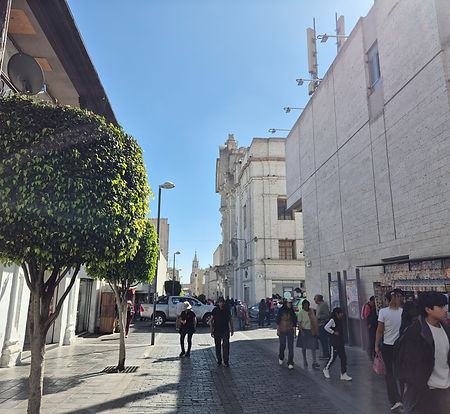
This is from the area near the Plaza de Armas. You can see where it gets the nickname "White City"
Around Town
Like most towns in Latin America, most of the interesting stuff for tourists is all built around the Plaza de Armas.
One of my favorite places to visit here is Mercado San Camilo. This is one of the bigger markets I have seen in the region, and it has got a little of everything. If your lodging is set up to where you can cook, this place will have all the staples you need. Mass, a discount grocery store, is another good place to get the basics, it's where I did most of my shopping since I wasn't too close to the market. Their fruit and veggie selection was limited, but you can find someone on almost every corner selling those anyway.
It also has a lot of food vendors. In the area around here, there will be a lot of more upscale restaurants catering to tourists. I didn't eat at a single one. Any time I was in the area, this is where I got lunch. Now, don't take that as me being pretentious and too good for "tourist food"—there were some places that looked great. Just as a solo traveler, I don't often go to sit-down restaurants where you've got to wait for your food. I just prefer the market food: sit on a crowded bench, scarf down a 10-soles sandwich, and get back to exploring.
There are some decent museums in the area, but be aware of one of the more popular ones, Museo Santuarios Andinos. I heard a lot about this one on travel sites, but when I actually got there, I decided to skip it. It has an entrance fee of 25 soles ($7.35), which is kind of pricey for the area, and you are required to have a guide. These are just people working for tips. It's not that I would have minded tipping them—I just didn't want a guide at all, so I skipped this place.

Church and Convent of Santo Domingo

Bird's eye view of Mercado San Camilo
While you are in the area, don't miss walking across the Puente Grau bridge. I stumbled upon this while heading to Mirador de Yanahuara, a popular viewpoint, but from this bridge, you get a great view of Misti Volcano.
When you cross this bridge, you get into a much more modern and commercial area of town, but if you head north, you get out of that pretty quick. Once I got to Yanahuara, I saw a few more lookouts on the map, so I just kept going. I walked along some pretty rural farmland and got some more great shots of the mountains. I made it all the way up to Plaza Carmen Alto before I decided I was out of gas and got a taxi for the ride back home.

Perfect shot of El Misti from the Puente Grau Bridge

The arches at the Yanahuara Scenic Overlook. Probably the most popular view point in town.

I love this shot. Chachani to the left and Misti to the right taken from the northern edge of town.

Chilled out and rested with the general while waiting for a taxi at Plaza de Carmen Alto
Santa Catalina Monastery
If you come to Arequipa and are only going to see one thing, that thing should be the Monasterio de Santa Catalina de Siena. It is located in the city center of Arequipa and is really a city within a city. It looks like it could be a fortress or citadel because of the 20-foot-high walls completely encircling it. If your luck is like mine, when you find the monastery you will think, "OK, I'll just follow the wall in one direction and that will take me to the entrance." That is true, but I walked almost completely around the 20,000 square-meter complex, and if I had just walked the other direction, I would have found the entrance in about 50 meters.
The cost to enter is 50 soles ($14.50), and you can get a guide for an additional tip. As usual, I didn't get one, but this is a spot that may be worth it. This place is seriously huge, big enough to get lost in, in fact. If you don't get a guide, I'd recommend taking a picture of the map at the front to follow. It is so big there are named roads within it to navigate. There is a spot where you can get on a roof and get a view of everything, but this is one of the few times that higher isn't better, because the view of the modern city outside kinda ruins the immersion of the ancient monastery inside.

Ever play a video game and it looks artificially large because you can't go in most of the rooms. Well all of these rooms are open. The section at the north edge that isn't mapped out is restricted because some nuns still live there.

Notice the street signs? That temple in back has a spot to climb and see the bird's eye view of the place.

I'm pretty sure this was for laundry and really hoping they weren't toilets.

Most of these kind of places will show you one kitchen, one bedroom etc. This place had several different kitchens in it.

One of the many courtyards.

Inside the main temple.
Day tours outside of Arequipa
There are three main day trips available in Arequipa but like usual, when searching there may appear to be much more when places offer small variations of the different tours. The links below will take you to the three. I just posted them in the order I did them, but it also happens to be the order I consider worst to first but all of these tours were a good time and worth the money and time spent.
-
Laguna de Salinas - There are a couple of stops but the main event is a giant salt flat
-
Catarata Pillones and the Stone Forest - This has two equally cool stops, a waterfall and stone forest. It is also kind of dangerous.
-
Colca Canyon - This is a one- or two- day tour to one of the deepest canyons in the world. There is a hike option available, but isn't really recommended for the average tourist. Everything I read said this was an extremely challenging hike.

Plaza de Armas at daybreak. This is where and when most tours meet up. It is otherwise deserted and made for some great photos.
Final Thoughts on Arequipa
As I said earlier, this was one of my favorite stops in Peru. It's like the biggest little town in South America. Plenty of stuff for the sightseer passing through for five days, and mellow enough for the backpacker staying for six weeks.
The weather was also a nice change of pace from Cusco. It actually didn't rain once in my whole six weeks there, and it was always pleasant.
From here I was originally planning to take a bus from La Paz, Bolivia and maybe spending a day or two around Lake Titicaca and I still think that would have been a good choice, but Bolivia was one of the few countries in South America that required a visa for Americans. It was kinda pricy and required bank statements and extra paperwork. With that and the elevation being even higher than Cusco I just didn't want to deal with it. As of December 2025 this is no longer the case though (the visa process I mean, the altitude hasn't changed) and Americans can get a 90-day visa on arrival.
One piece of advice for when you're leaving: On a day that isn't your last, pretend to book an Uber from your lodging to the airport or bus station at the exact time you need to leave to see how long it will take at that specific time of day. I always do this, and it really paid off here.
I arrived in town early afternoon, and my ride from the airport took 20 minutes. But on the way out, I had a late flight and left around rush hour, and it took two hours to get to the airport. If I had only given myself 20 minutes, I would have missed my flight.