
Can Gio Mangrove Forest: Also Called Monkey Island for Obvious Reasons...

This was a good trip and at 650,000 VND ($25), a good bargain too. I've taken dozens of day trips around the world. I used to think, "Holy shit, a new ruin to see! Yes, please!" While I still take pretty much any and all opportunities to see a new place, I have found the excitement waning when I find that it is a "mere 3.5 hours away". This coming from an American where road trips are a way of life.
The ride there isn't entirely awful, if you are lucky. The catch is you have to take a ferry, and after about 90 minutes, the road just dead-ends into a ferry dock. On the way there, we just waited an hour to move 500 meters. To add insult to injury, you'll see hundreds of motorcycles pass you as they load vans on the boat four to six at a time.
But those are just minor complaints. Pop in some headphones or take a nap. This isn't one of the tours where you gotta wake up at 4 AM, it leaves around 8 AM.
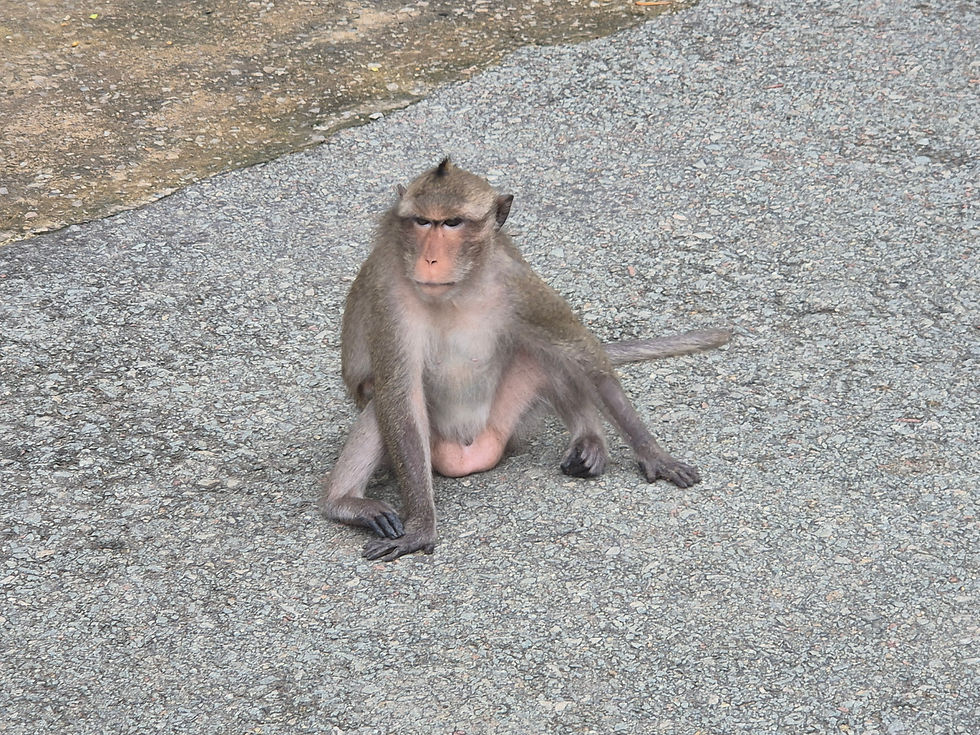
As soon as you walk in the gate to the park, you will see tons of these critters just wandering around. Most were the long-tailed monkeys shown above. Our guide warned us there were two kinds and the short-tailed monkeys were a little more aggressive. I wouldn't say you need to worry about getting attacked, but you can tell they have a little more attitude to them. They were kind of mean to other monkeys. Think of them like the drunk assholes stirring up shit at a party. I only saw a couple of them, though. It was about a 1:50 ratio between the two species.

Your guide will give each person a handful of peanuts to share with the monkeys. Strip club rules apply here: the monkeys can touch you, but you can't touch them. They are still wild animals, not dogs who enjoy scritches. They will bite if you try.
Other than that, the monkeys are surprisingly aloof to all the humans. They take the peanut (and show zero gratitude), but they really just seem like, while they enjoy the peanuts, they couldn't give a shit less if people were there or not. I'm always a little wary of eco-tourism involving animals, but I think, all things considered, the human footprint here is relatively small and not doing much harm to the area.

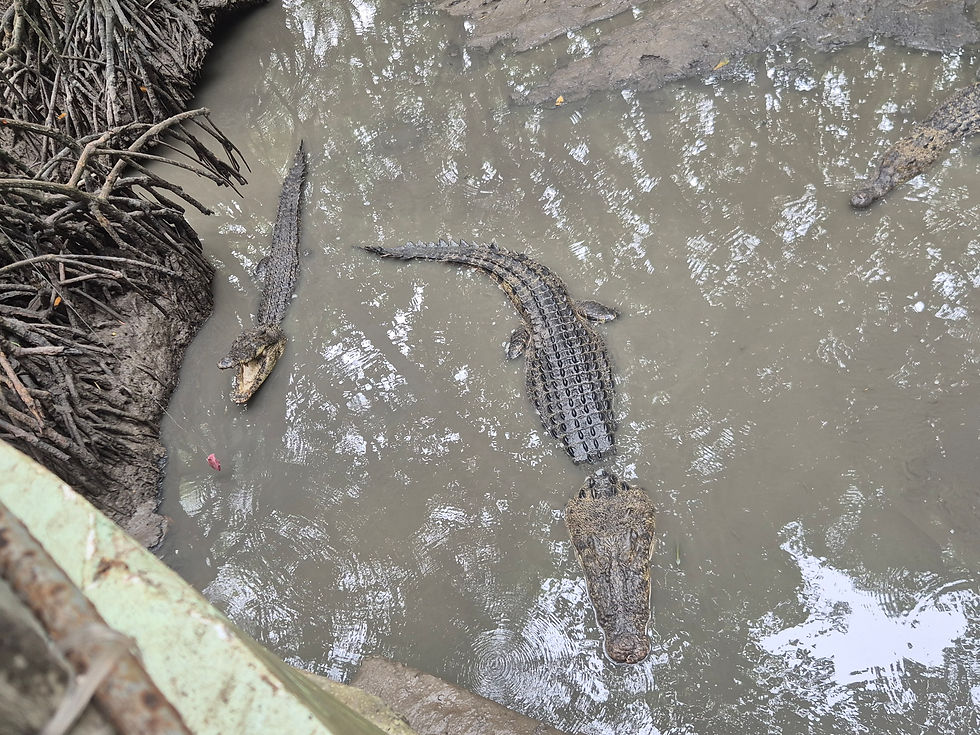
Next up is "crocodile fishing." You will go along an elevated path to a platform surrounded by crocodiles. For 20,000 VND ($0.75), you can get a pole with a piece of meat tied to it and feed them. There isn't a hook, of course, so don't worry about hurting them.
I just dropped mine down there and let the crocodile grab it and rip it off. Some people dangled the meat about a foot off the ground. I didn't care for people doing this, and honestly, the crocs didn't seem to like it much either and didn't really play into their game. None jumped up to grab the meat.
If you decide to fish, just let them have it.
This is pretty much the end of the animal section of the tour. Next you'll walk along a path pretty deep into the mangrove for some history on the war. This whole area gives you a sense of how unhospitable this place was. I don't really know the textbook definition of the difference between the jungle and the forest but I always lean toward "you can camp in the forest, the jungle wants to kill you." This is the jungle!
I can't imagine battling these mangroves day in and day out for months.
They did build elevated walkways for living areas in day to day life, but you got to venture out sometime.

After walking through a path in the forest, you come to a sketchy-ass wooden path. The guide tells you to walk single file down the middle. You can feel these boards bending and creaking, but you eventually get to the base where you still gotta be careful, though the walkway is much steadier.
There, it is a maze of walkways and grass-covered huts that give you a glimpse into how Vietnamese soldiers lived during the time.

Once you get here, you all meet and the guide tells you a little bit about life here. This was one of the primary locations that the U.S. military sprayed with Agent Orange, an industrial-strength herbicide, with the idea that if they could destroy the jungle, it would take away the Vietnamese advantage.
Now... I'm not calling our guide a liar, but my bullshit detector went off with a couple of the stories she told.
She said the crocodiles were a big problem for the soldiers and that nearly 1,000 were killed by them in this area. She also said they started attaching bombs to ducks, and the crocodiles would eat them and blow up.
The bomb thing made no sense to me, because I don't think the soldiers had spare explosives lying around to be wasted on critters.
After doing a little research, the body count appears to be correct, but it is the total casualties for this area over a ten-year period. About half of the bodies were never recovered, and several were likely eaten, but most deaths came from disease and combat. Artillery and airstrikes also make bodies hard to recover.
It is a good story and part of the lore of the area, and they have a monument built dedicated to the soldiers that even has a crocodile as part of it.

When you are done seeing the area, you don't have to walk back. A boat picks you up for the a ride back to the entrance. It is only about a five minute ride but it is a cool ride. Even better is the driver tries to make it fun. He took corners way sharper than needed and zig zagged a lot to make it exciting.

After this, we headed to a place for a lunch that was included in the cost of the tour. I wasn't really impressed with the food. It was a family-style setup, which I'm generally not a fan of. It wasn't awful, but nothing special.
Like all of the tours I have been on, they do stop at a place to try to sell you stuff, but unlike the other tours I have been on, it isn't disguised as an attraction. It is just a seafood market... but quite pungent.

It was interesting, but I was really curious what would happen if someone did buy a pound of fish or something. I hope they had a plan instead of just bringing it back to their seat for the 90-minute ride back home.

All in all, I think when considering time, value, and cost, this was the best tour I took in Vietnam, but I have a two-day, one-night trip planned to the Mekong Delta in a couple of weeks. So stay tuned.


Comments