

Cuenca
Botanical Gardens and Rio Yanuncay, Cuenca Ecuador
Time spent: 41 days; 22 Feb 2025 - 4 Apr 2025
Elevation: 8,399 ft (2,560 m)
Currency: US dollars
Lodging Cost: $22.00 per night; Airbnb
Arriving in Cuenca
This little gem of a town is one of my favorites in South America. Honestly, if I had come here before Quito, I might have ended up just riding out the entire 90-day visa here. There is just so much to like about this town. For one, it doesn't have the gridlocked traffic of many cities in South America, so no constant cacophony of car horns singing their song. The water is also some of the cleanest in South America. You can drink it straight from the faucet, and honestly, the water in my Airbnb tasted better than the water at my house in the States. I also found it to be one of the greenest cities I've seen in Latin America. I mean that literally too. I have no idea where their electricity comes from, I just mean it had so many green parks. There are also four main rivers that run through the town west to east. It feels like anywhere you go, you could always hear a babbling brook.
The airport is tiny, so you'll have no trouble navigating it. There is no Uber here, but there will be cabs waiting outside. These are all legit cabs and they use a meter, so you shouldn't have much trouble getting to your lodging. If you are staying in Centro Historico, you take a train directly from the terminal gates.

Catedral de la Inmaculada Concepcion in Centro Historico. Mostly just known by Caterdral Nueva.
Things to do around town
One of my favorite early morning things to do was just take a walk around Parque El Paraiso, do some people watching, and grab a juice. It is the biggest park in town, and it's full of people walking their dogs and exercising. I really enjoyed it because pretty much the whole walk from my apartment to the end of the park was along the river.
Near the park is a street called Calle de las Herrerias, or Blacksmith Street. It has a real Wild West feel to it; it has a cobblestone road, and the buildings have wooden balconies. It just feels kind of like a little frontier town. It also has some of the best restaurants, and you can get a meal for under $5 in most places. Tigrillo is one of the best dishes I've had on my travels, and it is all over in this area. It is plantains scrambled together with eggs and cheese.
And of course, it wouldn't be a complete trip without checking out the botanical garden. The garden here in Cuenca is free to visit and a little different from most I've been to, it has fewer trees and feels more like a literal garden, with a path taking you past several crop plots that almost look like student projects. (The header photo shows the path cutting through it.) The whole park sits right where two rivers meet, with bridges crossing both. Since this was just a few blocks from my apartment, I spent many a lunch break taking walks through here.

A meal fit for a cowboy

Rio Yanuncay running through Parque el Paraiso

Plaza del Herrero with a statue of Vulcan, the god of fire and metalwork...imagine being a god and still stuck doing blue-collar works

One of the many gardens. Be warned, you may have a battle of fisticuffs with a duck.

Path to nowhere in the garden. Must be some art piece. Very pretty, just not to practical.
Museo Pumapungo
I couldn't believe I almost missed this place. A lot of times when I am looking for something to do in a town, I just scroll across Google Maps. Usually, if something is in a tan or green section, it is worth checking out. This wasn't. I only even discovered it because I was out walking one day and could see a giant hill, so I looked closer on Google to see what it was.
It is a giant ruin in the middle of town and has a really nice museum attached. If this place were outside of town, it would be worth taking a special tour to go see it. Instead, you can enjoy it for the low cost of $0. Wherever you are staying, is likely within walking distance of this site.
There are 3 main parts to see. First, the museum. The museum itself is a decent size; you could spend an hour in there with all of the exhibits. Then you walk out the back of the museum, and outside you will be at the top of the ruin. The foundations for the ancient buildings are still here, and from the top you can see a circular garden. You can make your way down from the top and walk along the paths. In the back, there are even a few llamas. After that, there is a bird sanctuary.
Any three of these things on their own would be worth an admission ticket. But the fact that it is free makes this a can't-miss spot if you are in Cuenca.

This is a panoramic video I took from the top. You can see the garden, bird sanctuary and the whole town

Inside the museum. It is quite modern. There also some full size displays of homes of the era.

This is the foundations of the buildings that were once here. They were built of wood with grass roofs so they don't stand the test of time to well

Getting down from the top is easy with the switchbacks. To leave you will likely go up a steep staircase near the bird sanctuary

The Pumapungo bird sanctuary
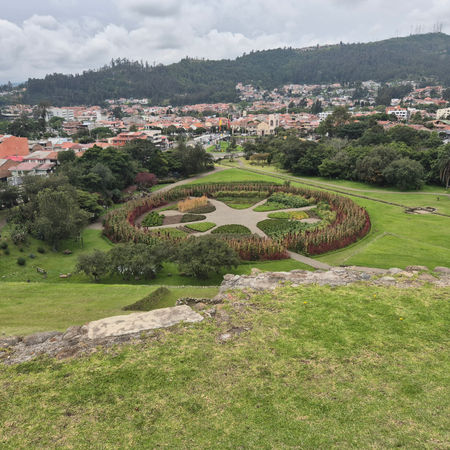
The garden at the bottom. It had so many different types of corn and huge colored fruits and vegetables. Looked like something out of Avatar

I thought this was a cool map of old town. Instead of a paper built into a stand, it is actually made with tile and on a building

Elmer Fudd should have been hunting Porky Pig's delicious ass instead

A sample of the brick architecture common throughout Centro Historico
Centro Historico
Just like Quito, Cuenca's Centro Historico district is also a UNESCO World Heritage Site. I liked it a lot better than Quito's city center; this really felt like it was from a different era. Once you cross the bridge over the Tomebamba River, you'll go up a pretty large set of steps, and it is like stepping into a different time.
The buildings in this area have a distinct colonial architecture that sets them apart from the rest of the city.
Also check out the markets. There are a few in the area, each named after historical dates. When going to any of the markets, you have GOT to try Hornado. They will have a whole cooked pig. The meat is so tender and the skin will be on the side, and it is crunchy and delicious. It will usually come with a side of llapingachos and some mote (hominy). The llapingachos are another piece of Latin magic themselves; they are just potato cakes and cheese, but somehow those two ingredients make for one of the best things I've tasted.
I think the best market was Mercado 10 de Agosto, but if it is Hornado you are after, they all had it.

From the top of the Catedral de la Inmaculada Concepción

The stairs entering Centro Historico
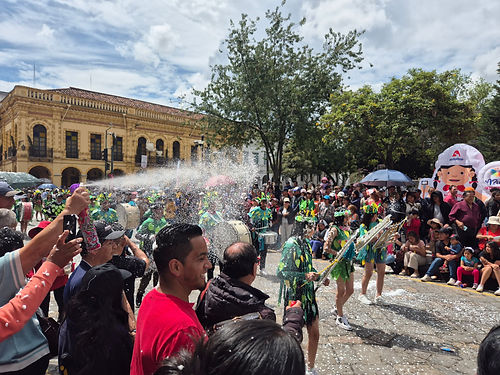
Everyone was smiling and having a great time. It was infectious. Even if you were like me and didn't have a clue what was going on
Carnival
I was fortunate enough to be here during Carnival. This is the Latin American version of Mardi Gras. It is celebrated at the same time and for the same reason: the start of Lent. And the celebrations are also similar; big parades, lots of costumes, though unfortunately not as many titties.
Also just like Mardi Gras, it isn't celebrated equally everywhere. While everyone knows about it, only some cities go all out for it. I had so much fun here, I made sure to plan ahead so I'd land in another city that went all out for it the next year, and ended up in Ayacucho, Peru.
The city broke a Guinness World Record while I was here by making the biggest pot of mote pata, a thick stew made of pork and hominy. After it was certified, they started handing out bowls. To the underprivileged sector of the community, the bowls were free, but to tourists and the general public, they were $2. I'm pretty sure they do this every year and just keep breaking their own previous record.
Also for about three days, the spray foam was everywhere, not just at the parties. People on random streets would be spraying each other. If you are really a curmudgeon and don't want to get sprayed, you could probably avoid it outside of the parades, but if you are at the parade, you will get foamed. It doesn't stain and dries quickly, so it shouldn't be an issue for anyone. I had a blast with it.
Each group has a theme, but just like Mardi Gras, I didn't really know or care what the theme was and just enjoyed watching the show.


The start of the path around Ingapirca. You can see the Temple of the Sun in the distance.
Ingapirca
Usually when I go on day trips I try to make a separate page and really break it down, but for this there really wasn't much to the tour and it really takes about half a day. It costs about $60 and maybe it was worth it. The place only takes about an hour and a half to get to, but it is pretty remote and up in the mountains; you wouldn't be able to get a cab there. Maybe take a bus to Canar and then catch a cab if you are really pinching pennies.
There were only three of us on the tour, all solo travelers, and we just rode in the guide's Jeep Cherokee. The guide was pretty knowledgeable and explained the history of the place pretty well. He also spoke excellent English. And as far as ruins go, this is a good one, probably the best site in all of Ecuador.
The whole ruin is set in a large semi-circle. It is different from most ruins because it was originally built by the Canari people and then was later expanded by the invading Inca Empire. The centerpiece of the ruins (although not in the center) is the Temple of the Sun.
The stonework here is really considered a technological marvel. It is mortarless and is just built with PERFECTLY interlocking stones. Like seriously perfect, you couldn't slide a sheet of paper between them. I think it was a real pain in the ass to make because all the walls around the place use mortar until you get to the temple and it has the fancy walls.
After here you will make a quick stop in Chordeleg. This town is like the jeweler capital of Ecuador. Apparently these people know their shit when it comes to making jewelry and this is THE PLACE to buy but it was lost on me. About 90% of the shops here are jewelry stores.
This shows pretty much the whole site


The top image is from the temple. See how the stones just fit, compared to the bottom which are held in place with mortar?

Free range llamas

The temple of the sun. If you zoom in, you can see the stonework.